If you’ve Googled anything lately and noticed a big AI-generated block sitting above every result congratulations, you’ve just met the thing that’s quietly reshaping how customers find service businesses like yours. AI search visibility for service businesses isn’t a future problem. It’s a right-now opportunity, and the businesses who move on it early are going to be very glad they did.
I’m going to walk you through exactly what’s happening, why it matters, and most importantly what you can actually *do* about it this week.
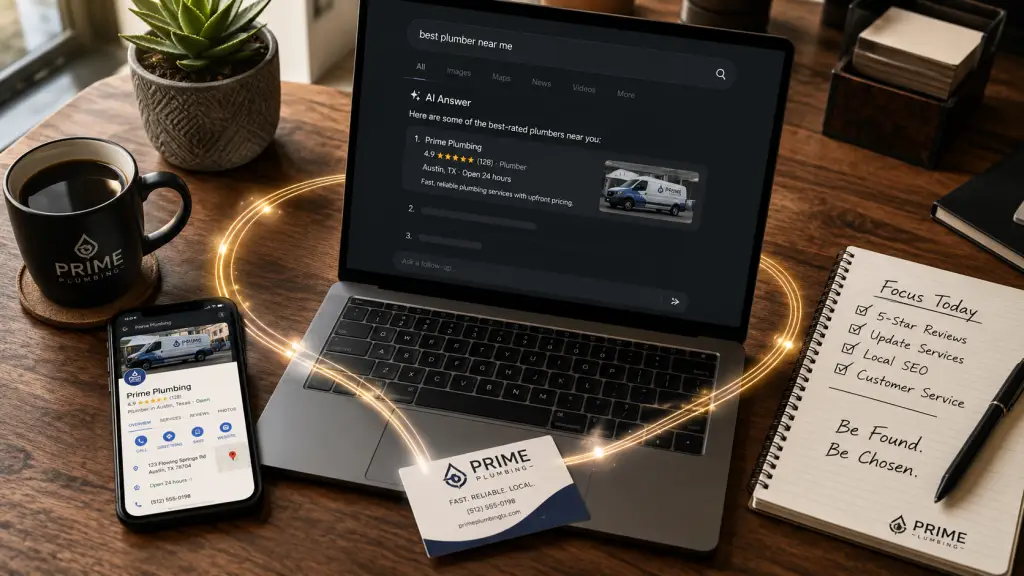
AI tools like Google AI Overviews, ChatGPT, and Perplexity are now answering questions directly, often without users clicking any links at all. To stay visible, service businesses need to optimize for Generative Engine Optimization (GEO) which means structured content, authoritative mentions, a polished Google Business Profile, and answer-focused writing. The good news? The foundations are the same solid local SEO you probably already know.
Why AI Search Visibility for Service Businesses Is a Big Deal Right Now
Here’s the uncomfortable truth: the old search game is changing fast.
Traditional SEO’s influence is eroding as user behavior shifts dramatically by early 2025, only 40.3% of U.S. Google searchers clicked on any organic result, down from 44.2% the year prior. Users increasingly expect direct answers instead of visiting websites.
Think of it like a restaurant where the waiter used to hand you a menu now the waiter just tells you what you’re having.
AI platforms like ChatGPT, Perplexity, Gemini, and Google AI Overviews now generate direct answers built from structured facts, citations, and high-authority sources.
And here’s the kicker: generative AI visibility is growing 165x faster than organic search, yet most businesses remain invisible to these new search platforms.
That’s not a typo. 165 times faster. So while your competitors are still arguing about meta descriptions, there’s a whole new visibility frontier wide open.
According to Capgemini, 58% of users have already replaced traditional search engines with AI-driven tools for product and service discovery.
That’s more than half your potential customers. And 64% of customers express readiness to purchase products suggested by AI.
So when an AI mentions your plumbing company, your law firm, or your bookkeeping service that’s a warm referral, not just a click.
What Is Generative Engine Optimization (GEO), Exactly?
You’ve heard of SEO. GEO is its cooler, slightly more complicated sibling.
GEO doesn’t compete with SEO; it complements it by tailoring content for generative answer engines like ChatGPT, Perplexity, Gemini, or Copilot. SEO fights for clicks; it’s about ranking in Google results, CTR, and keyword semantics, requiring the user to click a link. GEO competes for citations, with AI answering on behalf of the user, often without visiting any website.
Put simply: traditional SEO gets you a spot on a list. GEO gets you *mentioned in the answer*. Big difference.
Being referenced in an AI answer is the new “position zero.”
And for a service business, being that trusted citation is worth more than a dozen page-two rankings.
The Zero-Click Search Reality
The rise of zero-click searches means users increasingly rely on direct answers from generative engines rather than visiting multiple websites.
But here’s the flip side that most doom-and-gloom articles miss:
while AI Overviews reduce clicks for businesses that are *not* cited, they significantly increase visibility and authority for those that are pages cited inside AI Overviews can see click-through rates increase by up to 35% compared to businesses that simply rank organically.
So your zero-click search strategy isn’t about giving up on traffic. It’s about being the source that gets cited.
5 Practical Steps to Improve Your AI Search Visibility
1. Nail Your Google Business Profile (Seriously, Don’t Skip This)
I know, I know you’ve heard this one before. But it’s more critical than ever.
Small local businesses with accurate business information, an optimized Google Business Profile, positive customer reviews, and helpful website content may improve their chances of being referenced in AI-powered search results.
Here’s something wild: as of late 2025, Google began replacing the manual Q&A feature with “Ask Maps,” where Gemini now scans your profile, website, and reviews to generate an instant conversational answer if a user asks “Does this place have outdoor seating and fast Wi-Fi?” the AI formulates an answer based on the data it finds in your reviews and service attributes.
Translation: if your profile is thin, incomplete, or out of date, the AI will say something vague or worse, mention a competitor.
Fill in your business description, services, attributes, hours, and categories. Optimizing your Google Business Profile remains one of the most impactful ways to enhance your local SEO, including ensuring your NAP (name, address, phone) is consistent and regularly uploading fresh photos.
2. Write Content That Answers Actual Questions
AI engines are basically the world’s most well-read research assistants. They love content that’s structured, clear, and directly answers what people are asking.
Creating answer-focused content like FAQs, how-tos, and lists, publishing original research and data that AI systems are likely to quote, and building brand authority through mentions in reputable sources are all key GEO strategies.
Think about the questions your customers ask you on calls. Write those down. Then answer them clearly on your website. That’s your content strategy. It’s not glamorous, but it works.
3. Build Topical Authority With Content Clusters
Don’t scatter your content across random topics like confetti at a parade.
Focus on creating clustered content around a particular area instead of writing one article on “Google Business Profiles,” write a full topic cluster on optimizing Google Business Profiles, review management, local SEO, citation building, and more.
When AI sees you consistently covering a topic with depth and expertise, it starts treating you like the authority you are.
Building content clusters around your service offerings, paired with consideration-stage articles that answer the questions buyers are actively asking, can get pieces surfacing across Google AI Overviews and multiple generative engines, bringing in qualified leads.
4. Get Mentioned on Authoritative External Sources
This one is often overlooked by small service businesses.
Whitespark’s 2025 Local Search Ranking Factors survey noted that visibility in AI Overview citations correlates more strongly with brand mentions on authoritative sites than with traditional pack ranking factors being talked about on trusted industry sites and news outlets matters more than ever.
Local press, industry associations, guest posts, and podcast appearances all count here. Every legitimate mention is a signal that says, “hey AI, this business is the real deal.”
5. Structure Your Content for Machine Readability
Use structured frameworks: expert quotes, statistics every 150–200 words, and clear comparison tables to make content highly machine-readable.
Use proper heading hierarchies, schema markup, and short clear sentences.
Writing clear headings, FAQ-style sections, bullet points, and schema markup are among the core factors that help content rank in generative engines.
And don’t forget: content quality, relevance, and authority are likely much more important for AI Overview rankings than physical distance, so a service business with a great website in a competitive city can absolutely outshine a bigger name with a lazy online presence.
What About Reviews? Do They Still Matter?
More than ever but not just the star rating.
AI Overview doesn’t simply count stars. Google’s NLP systems analyse review text at scale, extracting sentiment and themes a plumbing business with 4.8 stars but consistent “no-show” complaints may be excluded, while a 4.4-star competitor praised for “punctuality” gets featured. Reputation management has shifted from optional to existential.
So yes, keep asking for reviews. But also encourage customers to be specific. “Great service” is fine. “They fixed our burst pipe in 45 minutes on a Sunday” is what the AI is actually reading.
FAQ: AI Search Visibility for Service Businesses
Q: Do I need a completely separate AI strategy from my regular SEO?
Not exactly.
You don’t need a separate “AI strategy” you need the fundamentals done well, and most local businesses still haven’t done them.
GEO builds on strong SEO foundations; the two reinforce each other rather than compete.
Q: Will AI Overviews hurt my website traffic?
It depends on whether you’re cited.
For purely informational queries, AI Overviews can reduce clicks; some studies measure a 58% drop for the top result. But for local-intent searches that end in a call, a visit, or a booking, the impact is smaller, and the visitors who do click tend to be more serious.
Q: How quickly can I expect results from GEO efforts?
Patience is your friend here but results do come. One real-world example: for a client in enterprise IT services focused on creating content tied to their service offerings, impressions grew from 65K in January to 449K in July 2025 within just six months.
Start now and you’ll thank yourself by next quarter.
Start Showing Up Where Your Customers Are Looking
Here’s the bottom line: your potential customers are asking AI tools who to hire. The only question is whether your business comes up in that answer or your competitor does.
AI search visibility for service businesses isn’t about gaming an algorithm. It’s about being genuinely helpful, consistently present, and clearly authoritative in your space. Polish that Google Business Profile, write content that answers real questions, build authority mentions, and structure everything so AI can actually read it.
You don’t need a massive budget or a team of engineers. You need to do the fundamentals well and keep showing up. The businesses that start this work today are quietly building a lead generation advantage that’s going to look very obvious in 12 months.
So what’s the first thing you’re going to fix this week?