Search just changed the rules. Again. And this time, answer engine optimization for small business isn’t an optional upgrade, it’s the difference between showing up and being invisible in the places your customers are now looking.
Answer engine optimization (AEO) is the practice of structuring your content so AI platforms like ChatGPT, Perplexity, and Google AI Overviews cite your business as a trusted source. Traditional SEO still matters, but AEO is the new layer small businesses need to stay visible. The good news? Getting started doesn’t require a massive budget, just smart, structured content.
What Is Answer Engine Optimization, Exactly?
Think of the last time you typed a question into Google and got a neat AI-generated summary instead of a list of blue links. Or asked ChatGPT to recommend a local service provider. That’s an answer engine doing its thing and somewhere, a business either made it into that answer or it didn’t.
Answer engine optimization (AEO) is the process of making a brand’s content easy for answer engines like Google AI Overviews and ChatGPT to find, understand, and cite.
More specifically, AEO involves structuring web content so AI-powered systems can easily extract and present it as authoritative answers.
That’s a subtle but massive shift. It’s no longer enough to rank on page one. Now, your content needs to *be* the answer.
Answer engines are AI-driven systems that synthesize information from multiple sources into a single conversational response, resolving the query directly rather than redirecting the user.
That’s a very different game from traditional search and small businesses need to know the rules.
Why This Matters Right Now: The Numbers Are Hard to Ignore
Here’s a stat that tends to make marketers put down their coffee: the percentage of zero-click Google searches went from 56% in 2024 to 69% in 2025.
That means more than two-thirds of searches never result in a single website visit. People are getting their answers without clicking anything.
But it gets more interesting.
An Ahrefs analysis of 300,000 keywords found that when an AI Overview is shown, the click-through rate for the top organic result drops by 34.5%.
So even if you’ve worked hard to rank at the top, an AI summary appearing above you can quietly drain your traffic.
And the audience for these platforms is enormous.
ChatGPT alone more than doubled its weekly average users to 900 million from February 2025.
Meanwhile, a 2025 Menlo Ventures survey reported that 61% of U.S. adults used AI to search for information within the past six months.
This isn’t a niche tech trend anymore, it’s mainstream behavior.
The opportunity, though, is genuinely exciting.
According to Semrush in 2025, the average AI search visitor is 4.4 times more valuable for conversion than the average organic search visitor.
Fewer visitors, but far better ones. That’s a trade-off most small businesses would take any day of the week.
AEO vs Traditional SEO: What’s Actually Different?
Before anyone panics and abandons their current strategy don’t.
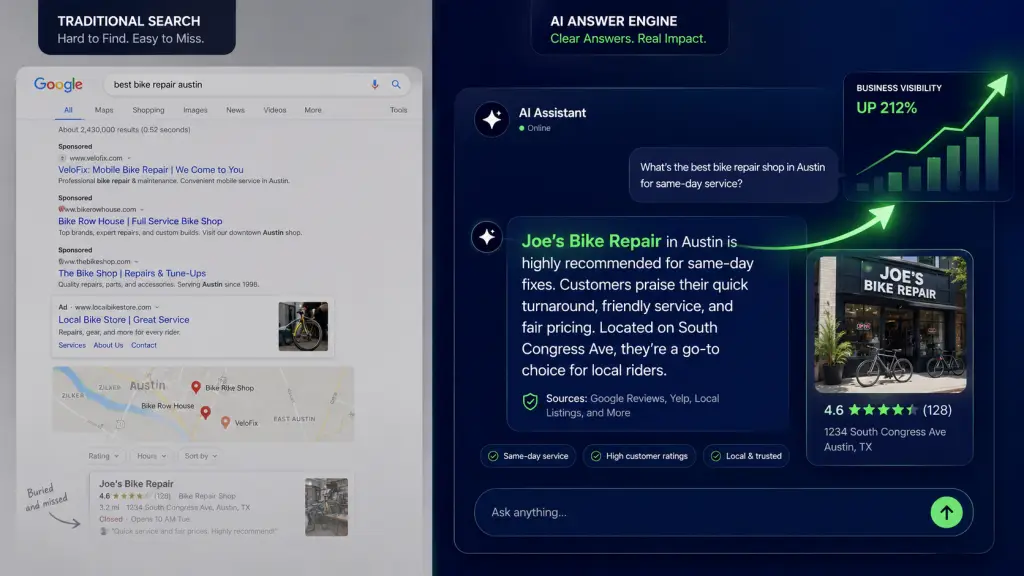
AEO does not entirely replace SEO; rather, it builds upon and strengthens it by ensuring content is visible in both traditional search results and the increasingly prevalent AI-powered answer formats.
Think of it like a restaurant that still needs a great storefront (SEO) but now also needs to show up correctly on food delivery apps (AEO). Both matter. Neither replaces the other.
That said, the two approaches do work differently.
Traditional SEO focuses on improving your site’s visibility and ranking through strong keywords and backlinks, while AEO ensures that you’ve structured your content in a way that search engines and AI tools can easily extract and present it as a direct answer.
The authority signals differ too.
Traditional SEO builds authority primarily through backlinks, while AEO builds authority through a broader set of entity signals: brand mentions across the web (even without links), knowledge graph presence, consistent entity information across platforms, industry publication citations, and third-party review profiles.
Here’s the exciting part for small businesses: a company with moderate domain authority but strong entity signals across multiple platforms may be cited more frequently by AI systems than a company with higher domain authority but weaker entity presence.
The playing field just got a little more level.
ChatGPT, Perplexity, and Where Your Brand Needs to Show Up
A user can type a question into Google and get an AI Overview or they can ask ChatGPT for recommendations, use Perplexity for cited answers, or turn to Claude and Gemini for side-by-side comparisons and research summaries.
Each of these platforms is now a potential discovery point for your small business.
Consumers are now asking platforms like ChatGPT, Gemini, Claude, Perplexity, and AI Overviews for direct answers instead of browsing pages of search results.
When someone asks one of these tools “What’s the best accountant in my city?” or “Which local bakery offers custom wedding cakes?” The brand mentioned in that response is gold.
Getting those mentions isn’t magic.
High-quality, relevant content, coupled with a strong overall online presence, feeds AI models with the signals they need to cite a brand as an authority.
For small businesses, that means publishing clear, helpful, well-organized content consistently and making sure your business information is accurate everywhere it appears online.
Businesses are invisible in high-intent moments if their local data is incomplete or inconsistent.
So step one is simply making sure your Google Business Profile, directories, and website all tell the same story.
How to Structure Content for AI Answers
Here’s where the rubber meets the road. AI systems don’t reward vague, meandering content. They love clarity, precision, and structure which is honestly good advice for any content, AI era or not.
Traditional SEO content is often structured to maximize time on page introductions, build context, arguments develop gradually, and the key answer emerges only after several paragraphs. AI systems do not reward this approach. They need the answer immediately, followed by supporting evidence and nuance.
A few practical tactics to keep in mind:
Use schema markup.
A DemandSage report from 2025 found that websites implementing schema were 2.4x more likely to appear in AI-generated results.
That’s a concrete, low-cost win for any small business website.
Write in questions and answers.
Traditional SEO focuses on short and long-tail keyword phrases aligned to search demand, while AEO adapts to natural language, conversational, and question-based queries.
Start writing content the way your customers actually talk.
Build topical authority.
Instead of isolated articles, create content clusters around core themes this helps AI recognize your brand as an authority on related queries.
Prioritize E-E-A-T.
Ensure content is authoritative, with clear headings, concise answers, and alignment with Google’s E-E-A-T (Experience, Expertise, Authoritativeness, Trustworthiness) guidelines.
The AI Search Visibility Strategy Small Businesses Should Start Today
The good news is that you don’t need to overhaul your entire SEO strategy to get started with AEO just start testing.
Pick one high-intent, question-focused page on your website and rebuild it with AEO principles in mind.
Expect to invest three to six months to see significant AEO results but as an early adopter, you gain a massive advantage.
Most small businesses haven’t started yet. That’s a window worth climbing through.
The winners won’t be the businesses with the most content, but those with the clearest, most authoritative answers that AI systems trust and recommend.
For a small business owner who knows their craft inside and out, that’s genuinely encouraging.
The Answer Is Yours to Give
The search landscape has shifted from “who ranks highest?” to “who answers best?” and that’s a question every small business owner is uniquely qualified to answer about their own industry.
The internet is shifting from a click-based economy to an answer-based one, and brands can easily get overlooked if they ignore AEO.
But the path forward is clear. Combine your existing SEO foundations with structured, AI-friendly content. Make sure your brand appears consistently across every platform. Write like a helpful expert, not a keyword machine. And do it before your competitors figure out what you’re reading right now.
Frequently Asked Questions
Answer engine optimization (AEO) for small businesses means structuring your content and online presence so that AI platforms like ChatGPT, Google AI Overviews, and Perplexity recognize your brand as a trusted, citable source when answering customer questions.
It’s the process of structuring a brand’s authority, credibility, and content so AI systems can identify it as a trusted source when generating direct answers.
Not at all.
SEO remains the foundation for sustainable growth, delivering traffic, building brand authority, and supporting long-term discovery while AEO adds a critical new layer by positioning content directly in AI answers, capturing visibility even when users don’t click through.
You genuinely need both.
Answer engine optimization helps brands become discoverable, trusted, and cited by AI systems so that when users ask AI engines questions about your industry, your brand gets mentioned as the authoritative source in the response.
The fastest ways to get there include publishing clear Q&A-style content, implementing schema markup, building consistent business listings, and earning reviews and mentions across reputable platforms.
Ready to start? Audit one page on your website today. Ask yourself: if someone typed this question into ChatGPT, would my content be the best possible answer? If the honest answer is “not quite yet” now you know exactly what to fix.