
Online reviews aren’t just digital word-of-mouth; they’re a measurable ranking signal that directly impacts your local SEO ranking.
Review signals make up roughly 15% to 17% of how Google decides to rank a local business.
Businesses that actively collect, manage, and respond to reviews consistently outperform those that don’t. If your Google review strategy is on autopilot (or nonexistent), it’s time to change that.
Why Online Reviews and Local SEO Ranking Are Inseparable
Think of Google as a very discerning matchmaker. It’s constantly trying to pair searchers with the best possible local business and reviews are one of the loudest signals it listens to.
Reviews are more than just social proof; they’re a significant ranking factor for local SEO, and as a direct ranking factor related to prominence, they’ve become more influential than ever.
The numbers back this up.
Research shows businesses with 100+ reviews rank 20% higher in local packs.
That’s not a rounding error, that’s a meaningful competitive gap.
Google determines local search rankings based on three primary factors: relevance (how well your profile matches what someone is searching for), distance (how far you are from the searcher), and prominence (how well-known a business is).
Reviews heavily influence that third pillar. And here’s the exciting part: prominence is actually something you can build. Unlike proximity, you’re not stuck with it.
What Review Signals Map Pack Rankings Actually Measure
Not all reviews are created equal. Google doesn’t just count stars, it reads between the lines.
Search engines now use review quantity, quality, recency, and other review-related signals as key ranking factors.
Here’s what actually moves the needle for your review signals map pack visibility:
Recency matters enormously.
A few genuine reviews from last month carry more weight than dozens from two years ago.
Fresh reviews keep your profile active, and Google prefers businesses with reviews less than 30 days old, which can enhance rankings by 15%.
Volume beats perfection.
A business with 150 reviews at 4.6 stars will outrank a business with 12 reviews at 4.8 stars in most cases.
A slightly imperfect-but-abundant review profile is far more compelling to Google than a sparse collection of five-stars.
Velocity signals legitimacy.
Getting reviews consistently over time matters more than getting 50 reviews in one week, which looks suspicious.
Google watches for organic, steady patterns not sudden floods.
Review content fuels relevance.
When a customer writes “They did amazing kitchen remodeling work on our home,” they’re handing you a relevance signal on a silver platter Google scans review text to understand what services you actually provide.
Building a Smart Google Review Strategy for Small Businesses
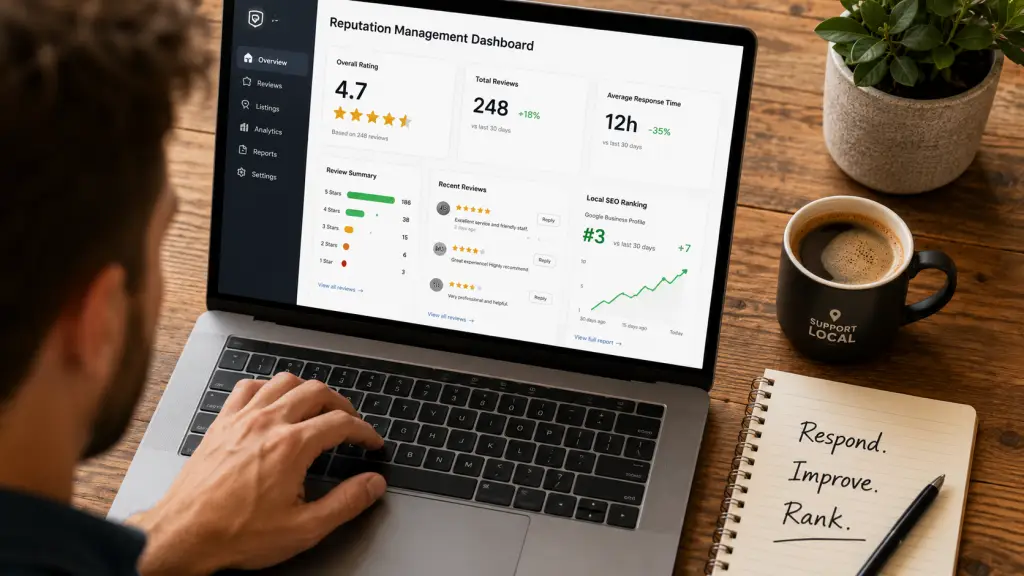
Reputation management for small businesses doesn’t require a big-budget agency. It requires consistency and a plan. Here’s how to build a Google review strategy that actually works.
Ask at the right moment. The best time to request a review is right when the customer is happiest, not a week later when the moment has faded.
Text a review link the moment the job wraps, stick a QR code on receipts, and train your front desk to ask when the customer’s smiling, not when they’re already out the door.
Prompt for detail, naturally.
Instead of asking “Please leave a review,” try: “We’d love to hear about your experience with our emergency plumbing team. Let us know what problem we helped you solve!” This subtle psychological nudge encourages customers to describe the service, naturally including relevant keywords.
Diversify your platforms.
While Google reviews carry the most weight, it’s wise to encourage reviews on Yelp, Facebook, and industry-specific platforms.
A multi-platform presence signals broader trust.
Never fake it.
If you build your online credibility on a flimsy foundation of fake reviews, Google could knock it down way faster than you built it up.
The algorithm is getting sharper at detecting unnatural patterns, and the downside risk simply isn’t worth it.
How to Respond to Negative Reviews (Without Breaking a Sweat)
Here’s a truth that surprises most small business owners: a negative review isn’t a disaster. Ignoring it is.
Negative reviews aren’t the worst thing for your business, not responding to them is worse, both from a ranking perspective and a human perspective.
Google has explicitly confirmed that responding to reviews improves your local SEO.
So yes, every response you type is doing double duty managing customer perception and feeding Google’s engagement signals.
When you respond to negative reviews, keep these principles in mind: Engaging with both positive and negative feedback professionally can improve engagement signals for your Google Business Profile and potentially even turn a negative review into a positive one.
Don’t copy-paste responses. Acknowledge details from the review, address concerns directly, and sign off like a human.
Businesses with consistent owner responses outrank businesses with similar review counts but no replies the response itself is a ranking signal.
Think of it like customer service that the whole internet gets to watch. Handled well, it’s some of the best free marketing a small business can get.
The Reputation Management Small Business Owners Often Overlook
Most business owners focus on getting reviews. Fewer focus on *managing* their reputation as an ongoing system. That’s the gap where competitors slip ahead.
The most important local SEO factors for small businesses now include not just having reviews but managing them well.
You must ensure you’re receiving a steady stream of new reviews because review recency is a local ranking signal to keep a trend of consistent, new reviews to maintain three-pack rankings.
You should also pay attention to how many reviews your competition is getting so you know how many you need to stay competitive.
This isn’t paranoia, it’s smart positioning. If your biggest competitor gains 20 reviews this month and you gain zero, the gap widens.
Beyond Google, keep an eye on your overall digital footprint.
Review recency, average star rating, the presence of substantive text content in reviews, and whether the business owner responds to reviews all contribute to how Google evaluates your review profile holistically.
Strong Reviews Can Even Overcome a Distance Disadvantage
Here’s something genuinely exciting for any small business not located in the centre of town.
Strong review signals can effectively override proximity disadvantages by building a fortress of positive reviews, you can expand your effective service area radius.
Exceptional prominence can partially offset a distance disadvantage.
In other words, a stellar reputation management small business strategy doesn’t just build trust it literally expands the geographic reach of your visibility. Reviews are one of the few local SEO levers that punch above their weight.
Frequently Asked Questions
There’s no magic number, but volume matters more than perfection.
Sterling Sky’s 2025 case study showed measurable local ranking improvements when tracked businesses crossed specific review count thresholds jumping from 9 to 10 reviews produced a noticeable ranking lift, but the cumulative impact of volume, recency, rating, and text content is substantial.
Yes and the data is clear.
Answering reviews signals engagement, and businesses responding to 80%+ of reviews see a 10–20% ranking boost.
Even a short, genuine reply sends a positive activity signal to Google.
According to the BrightLocal Consumer Review Survey, 68% of consumers won’t even consider a business under 4 stars.
Keep your average above 4 stars whenever possible both for ranking purposes and to avoid losing potential customers at the click-through stage.
Start Treating Reviews Like the Ranking Asset They Are
The connection between online reviews and local SEO ranking is no longer a nice-to-have insight. It’s the core of a competitive local strategy.
Google reviews aren’t just a nice bonus, they’re a critical part of your local SEO strategy. The right kind of detailed, photo-rich, and consistent reviews can help your business appear more often, earn trust faster, and stay ahead of the competition.
Build the task into your daily workflow. Respond to every review, especially the uncomfortable ones. Monitor your competitors’ review velocity. And never stop because the businesses showing up in those coveted top three Map Pack spots aren’t there by accident. They earned it, one genuine review at a time.
Ready to turn your reputation into your strongest ranking signal? Start with your next happy customer and go from there. If you need some help with ranking, we work with an amazing SEO and GMB partner in Las Vegas. Schedule a consultation with our SEO partner today.